



Björn Brembs @brembs · activity timestamp 6 yr. ago https://doi.org/10.1101/2021.01.15.426803 Reply Boost Quote Like More actions Copy link Flag this media Block
Björn Brembs @brembs · activity timestamp 6 yr. ago Current market rates for scholarly publishing services Reply Boost Quote Like More actions Copy link Flag this media Block
Björn Brembs @brembs · activity timestamp 6 yr. ago Current market rates for scholarly publishing... | F1000Research For decades, the supra-inflation increase of subscription prices for scholarly journals has concerned scholarly institutions. After years of fruitless efforts to solve this “serials crisis”, open access has been proposed as the latest potential solution. However, also the prices for open access publishing are high and are rising well beyond inflation. What has been missing from the public discussion so far is a quantitative approach to determine the actual costs of efficiently publishing a scholarly article using state-of-the-art technologies, such that informed decisions can be made as to appropriate price levels. Here we provide a granular, step-by-step calculation of the costs associated with publishing primary research articles, from submission, through peer-review, to publication, indexing and archiving. We find that these costs range from less than US$200 per article in modern, large scale publishing platforms using post-publication peer-review, to about US$1,000 per article in prestigious journals with rejection rates exceeding 90%. The publication costs for a representative scholarly article today come to lie at around US$400. These results appear uncontroversial as they not only match previous data using different methodologies, but also conform to the costs that many publishers have openly or privately shared. We discuss the numerous additional non-publication items that make up the difference between these publication costs and final price at the more expensive, legacy publishers. Reply Boost Quote Like More actions Copy link Flag this media Block
Björn Brembs @brembs · activity timestamp 6 yr. ago Current market rates for scholarly publishing services [version 2; peer review: 2 approved] Reply Boost Quote Like More actions Copy link Flag this media Block
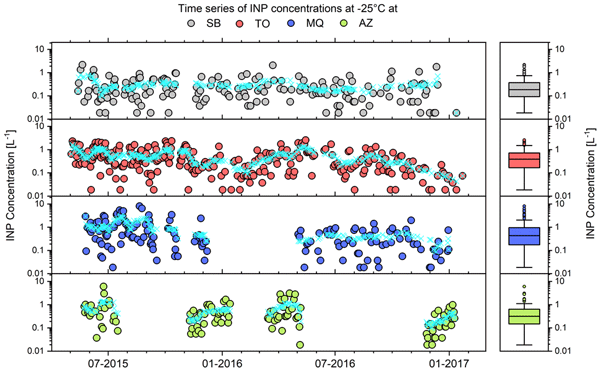
Jorge Saturno @saturno · activity timestamp 6 yr. ago Long-term deposition and condensation ice-nucleating particle measurements from four stations across the globe Abstract. Ice particle activation and evolution have important atmospheric implications for cloud formation, initiation of precipitation and radiative interactions. The initial formation of atmospheric ice by heterogeneous ice nucleation requires the presence of a nucleating seed, an ice-nucleating particle (INP), to facilitate its first emergence. Unfortunately, only a few long-term measurements of INPs exist, and as a result, knowledge about geographic and seasonal variations of INP concentrations is sparse. Here we present data from nearly 2 years of INP measurements from four stations in different regions of the world: the Amazon (Brazil), the Caribbean (Martinique), central Europe (Germany) and the Arctic (Svalbard). The sites feature diverse geographical climates and ecosystems that are associated with dissimilar transport patterns, aerosol characteristics and levels of anthropogenic impact (ranging from near pristine to mostly rural). Interestingly, observed INP concentrations, which represent measurements in the deposition and condensation freezing modes, do not differ greatly from site to site but usually fall well within the same order of magnitude. Moreover, short-term variability overwhelms all long-term trends and/or seasonality in the INP concentration at all locations. An analysis of the frequency distributions of INP concentrations suggests that INPs tend to be well mixed and reflective of large-scale air mass movements. No universal physical or chemical parameter could be identified to be a causal link driving INP climatology, highlighting the complex nature of the ice nucleation process. Amazonian INP concentrations were mostly unaffected by the biomass burning season, even though aerosol concentrations increase by a factor of 10 from the wet to dry season. Caribbean INPs were positively correlated to parameters related to transported mineral dust, which is known to increase during the Northern Hemisphere summer. A wind sector analysis revealed the absence of an anthropogenic impact on average INP concentrations at the site in central Europe. Likewise, no Arctic haze influence was observed on INPs at the Arctic site, where low concentrations were generally measured. We consider the collected data to be a unique resource for the community that illustrates some of the challenges and knowledge gaps of the field in general, while specifically highlighting the need for more long-term observations of INPs worldwide. Reply Boost Quote Like More actions Copy link Flag this media Block
Björn Brembs @brembs · activity timestamp 6 yr. ago Identification of FoxP circuits involved in locomotion and object fixation in Drosophila Reply Boost Quote Like More actions Copy link Flag this media Block
Björn Brembs @brembs · activity timestamp 6 yr. ago The brain as a dynamically active organ Reply Boost Quote Like More actions Copy link Flag this media Block
Konrad Hinsen @khinsen · activity timestamp 6 yr. ago ActivePapers: a platform for publishing and archiving computer-aided research. The lack of replicability and reproducibility of scientific studies based on computational methods has lead to serious mistakes in published scientific findings, some of which have been discovered and publicized recently. Many strategies are currently pursued to improve the situation. This article reports the first conclusions from the ActivePapers project, whose goal is the development and application of a computational platform that allows the publication of computational research in a form that enables installation-free deployment, encourages reuse, and permits the full integration of datasets and software into the scientific record. The main finding is that these goals can be achieved with existing technology, but that there is no straightforward way to adapt legacy software to such a framework. Reply Boost Quote Like More actions Copy link Flag this media Block
Konrad Hinsen @khinsen · activity timestamp 6 yr. ago Daydreaming about Scientific Programming Did you ever think about what your ideal work environment for scientific programming would be like? Here's my version of it. Reply Boost Quote Like More actions Copy link Flag this media Block
Konrad Hinsen @khinsen · activity timestamp 6 yr. ago Computational science: shifting the focus from tools to models Computational techniques have revolutionized many aspects of scientific research over the last few decades. Experimentalists use computation for data analysis, processing ever bigger data sets. Theoreticians compute predictions from ever more complex models. However, traditional articles do not permit the publication of big data sets or complex models. As a consequence, these crucial pieces of information no longer enter the scientific record. Moreover, they have become prisoners of scientific software: many models exist only as software implementations, and the data are often stored in proprietary formats defined by the software. In this article, I argue that this emphasis on software tools over models and data is detrimental to science in the long term, and I propose a means by which this can be reversed. Reply Boost Quote Like More actions Copy link Flag this media Block
Konrad Hinsen @khinsen · activity timestamp 6 yr. ago The molecular modeling toolkit: A new approach to molecular simulations The Molecular Modeling Toolkit is a library that implements common molecular simulation techniques, with an emphasis on biomolecular simulations. It uses modern software engineering techniques (object-oriented design, a high-level language) to overcome limitations associated with the large monolithic simulation programs that are commonly used for biomolecules. Its principal advantages are (1) easy extension and combination with other libraries due to modular library design; (2) a single high-level general-purpose programming language (Python) is used for library implementation as well as for application scripts; (3) use of documented and machine-independent formats for all data files; and (4) interfaces to other simulation and visualization programs. © 2000 John Wiley & Sons, Inc. J Comput Chem 21: 79–85, 2000 Reply Boost Quote Like More actions Copy link Flag this media Block
Konrad Hinsen @khinsen · activity timestamp 6 yr. ago Normal mode theory and harmonic potential approximations Normal mode analysis has become one of the standard techniques in the study of the dynamics of biological macromolecules. It is primarily used for identifying and characterizing the slowest motions in a macromolecular system, which are inaccessible by other methods. This text explains what normal mode analysis is and what one can do with it without going beyond its limit of validity. The focus is on proteins, although normal mode analysis can equally well be applied to other macromolecules (e. g. DNA) and to macromolecular assemblies ranging in size from protein-ligand complexes to a whole ribosome. By definition, normal mode analysis is the study of harmonic potential wells by analytic means. Reply Boost Quote Like More actions Copy link Flag this media Block
Konrad Hinsen @khinsen · activity timestamp 6 yr. ago Effektive elektrostatische Eigenschaften von Suspensionen Reply Boost Quote Like More actions Copy link Flag this media Block
Konrad Hinsen @khinsen · activity timestamp 6 yr. ago Parallel scripting with python Reply Boost Quote Like More actions Copy link Flag this media Block
Konrad Hinsen @khinsen · activity timestamp 6 yr. ago The promises of functional programming Adopting a functional programming style could make your programs more robust, more compact, and more easily parallelizable. However, mastering it requires some effort. This article's purpose is to explain what functional programming is and how it differs from traditional imperative programming. The author also explains how functional programming helps with concurrent and parallel programming. The language I use in the examples is Clojure, a modern dialect of Lisp. Reply Boost Quote Like More actions Copy link Flag this media Block
Konrad Hinsen @khinsen · activity timestamp 6 yr. ago Problem-Specific Analysis of Molecular Dynamics Trajectories for Biomolecules Reply Boost Quote Like More actions Copy link Flag this media Block
Nicolas Fressengeas @fresseng · activity timestamp 6 yr. ago GaAs-based monolithic high contrast gratings for mid-infrared VCSELs Reply Boost Quote Like More actions Copy link Flag this media Block
Nicolas Fressengeas @fresseng · activity timestamp 6 yr. ago Theoretical and experimental temporal self–focusing studies in photorefractive InP : Fe at telecommunication wavelength, Reply Boost Quote Like More actions Copy link Flag this media Block
Nicolas Fressengeas @fresseng · activity timestamp 6 yr. ago Development of Novel Thin Film Solar Cells: Design and Numerical Optimisation The development of cost-effective solar cells requires on the one hand to master the elaboration techniques, and on the other hand, an adequate design to optimise the photovoltaic efficiency. These two research topics are closely linked and their association in the research work is the key in the development of novel thin film solar cells. The design associated with numerical optimisation gives the set of optimal physical and geometrical parameters, taking into account the technological feasibility. This will allow elaboration to target the most efficient structures in order to speed up the final device realisation. In this work, we used a new approach, based on rigorous multivariate mathematical global Bayesian algorithm, to optimise a Schottky based solar cell (SBSC) using InGaN as the absorber. The obtained photovoltaic efficiency is close to the conventional structures efficiency while being less complex to elaborate. In addition, the results have shown that the optimised SBSC structure exhibits high fabrication tolerances. Reply Boost Quote Like More actions Copy link Flag this media Block
Nicolas Fressengeas @fresseng · activity timestamp 6 yr. ago Numerical investigations of the impact of low cost fabrication of Cu2O on solar cell performances The challenge of switching for photovoltaic as a major source of electricity can only be fulfilled by using solar cells based on low toxicity and earth abundant materials combined with a low cost process. One of the most promising solution to achieve this goal is to use a metal oxide absorber such as cuprous oxide (Cu2O). In 2016, a Cu2O/ZnGeO solar cell was demonstrated by the Minani group and reached a record efficiency of 8.1%. A recent modeling of Cu2O solar cells by Rizi et al. confirms that ZnGeO buffer layer outperforms other buffer layers reported experimentally due to a better band alignement. However the experimental and simulated results were obtained by taking into account a solar cell based on a high demanding energy process (T>1000°C). Cuprous oxide thin films have already been developed by low cost and large area compatible processes, but currently in detriment of material quality with grain size in the range of tenth of nanometers and mobility two order of magnitude lower. In order to evaluate the impact of low cost processes on solar cell performances, we analyse the modelisation results of Cu2O/ZnGeO solar cell by carefully taking into account experimental material properties, defects and grain size of Cu2O grown by low cost processes. The conclusion of this analysis will serve as a guideline for solar cells elaboration by spray pyrolysis in our laboratory and measurements of device performances will be compared with our simulated results. Reply Boost Quote Like More actions Copy link Flag this media Block