Discussion
Loading...

Explore local activities

  • About
  • Code of conduct
  • Privacy
  • Users
  • Instances
  • About Bonfire
Stefan Rödiger
@pangolin  ·  activity timestamp 4 years ago

A new reporter design based on DNA origami nanostructures for quantification of short oligonucleotides using microbeads

  • Copy link
  • Flag this media
  • Block
Stefan Rödiger
@pangolin  ·  activity timestamp 4 years ago

Genomic and Phenotypic Analysis of an ESBL-Producing E. coli ST1159 Clonal Lineage From Wild Birds in Mongolia

  • Copy link
  • Flag this media
  • Block
Stefan Rödiger
@pangolin  ·  activity timestamp 4 years ago

Adhesion of Salmonella to pancreatic secretory granule membrane major glycoprotein GP2 of human and porcine origin depends on FimH sequence variation

  • Copy link
  • Flag this media
  • Block
Stefan Rödiger
@pangolin  ·  activity timestamp 4 years ago

Analysis of three-dimensional biofilms on different material surfaces

  • Copy link
  • Flag this media
  • Block
Stefan Rödiger
@pangolin  ·  activity timestamp 4 years ago

Looptag fret probe system for multiplex qpcr detection of borrelia species

  • Copy link
  • Flag this media
  • Block
Stefan Rödiger
@pangolin  ·  activity timestamp 4 years ago

Fluorescence-encoded poly(methyl metharcylate) nanoparticles for a lateral flow assay detecting IgM autoantibodies in rheumatoid arthritis

  • Copy link
  • Flag this media
  • Block
Stefan Rödiger
@pangolin  ·  activity timestamp 4 years ago

Surface melting curve analysis with R

  • Copy link
  • Flag this media
  • Block
Stefan Rödiger
@pangolin  ·  activity timestamp 4 years ago

Serological and viral genetic features of patients with COVID-19 in a selected German patient cohort—correlation with disease characteristics

  • Copy link
  • Flag this media
  • Block
Stefan Rödiger
@pangolin  ·  activity timestamp 4 years ago

Methods for comparing multiple digital PCR experiments

  • Copy link
  • Flag this media
  • Block
Stefan Rödiger
@pangolin  ·  activity timestamp 4 years ago

Multiparametric antibody detection for diagnostics,Multiparametrische Antikörperdetektion für die Diagnostik

  • Copy link
  • Flag this media
  • Block
Stefan Rödiger
@pangolin  ·  activity timestamp 4 years ago

A multiplex microchamber diffusion assay for the antibody-based detection of microRNAs on randomly ordered microbeads

  • Copy link
  • Flag this media
  • Block
Stefan Rödiger
@pangolin  ·  activity timestamp 4 years ago

Investigation of commensal escherichia coli populations of cormorant hatchlings in the absence of anthropogenic impacts in remote areas of West Mongolia

  • Copy link
  • Flag this media
  • Block
Stefan Rödiger
@pangolin  ·  activity timestamp 4 years ago

A semi-automated, isolation-free, high-throughput SARS-CoV-2 reverse transcriptase (RT) loop-mediated isothermal amplification (LAMP) test

  • Copy link
  • Flag this media
  • Block
Stefan Rödiger
@pangolin  ·  activity timestamp 4 years ago

Access Denied

  • Copy link
  • Flag this media
  • Block
Stefan Rödiger
@pangolin  ·  activity timestamp 4 years ago
journal-article Life
LoopTag FRET Probe System for Multiplex qPCR Detection of Borrelia Species
Henning Hanschmann, Stefan Rödiger, Toni Kramer, Katrin Hanschmann, Michael Steidle, Volker Fingerle, Carsten Schmidt, Werner Lehmann, Peter Schierack October 31, 2021
doi:10.3390/life11111163
Read paper
  • Copy link
  • Flag this media
  • Block
Björn Brembs
@brembs  ·  activity timestamp 4 years ago
https://doi.org/10.1101/2021.10.04.463010
  • Copy link
  • Flag this media
  • Block
Björn Brembs
@brembs  ·  activity timestamp 4 years ago
bioRxiv

Pain is so close to pleasure: the same dopamine neurons can mediate approach and avoidance in Drosophila

In mammals, dopamine is considered a central neuromodulator involved in all kinds of rewarding experiences (‘common currency’ hypothesis). In insects, the role of do-paminergic neurons in aversive stimuli was discovered before dopaminergic neurons were found to also be involved in processing appetitive stimuli. Here, we screened about 50 transgenic Drosophila lines, representing different subpopulations of dopa-minergic neurons for their ability to sustain approach or avoidance behavior, when activated optogenetically in four different operant self-stimulation paradigms. None of the lines sustain consistent behavioral valence in all experiments. Individual lines sustain approach in one experiment and avoidance in another. One line mediated strong avoidance early in the experiment and weak approach in later stages. The evidence presented here appears to contradict a ‘common currency’ dopamine function in flies. Instead, different dopaminergic neurons convey valence in a context-dependent and flexible manner, reflecting the genetic heterogeneity of the dopaminergic neuronal population. ### Competing Interest Statement The authors have declared no competing interest.
  • Copy link
  • Flag this media
  • Block
Jorge Saturno
@saturno  ·  activity timestamp 4 years ago

Optical properties of coated black carbon aggregates: numerical simulations, radiative forcing estimates, and size-resolved parameterization scheme

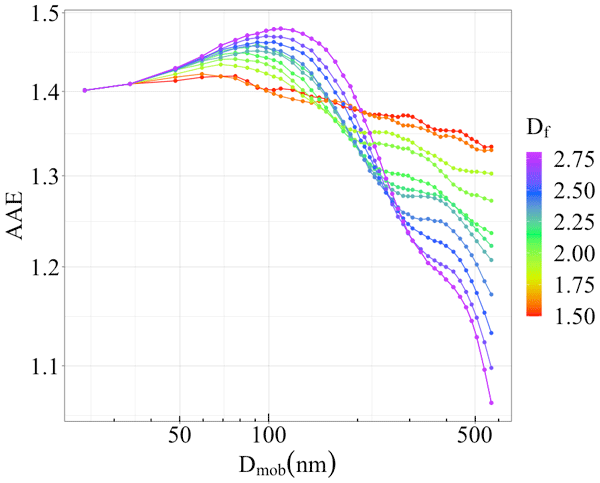
Abstract. The formation of black carbon fractal aggregates (BCFAs) from combustion and subsequent ageing involves several stages resulting in modifications of particle size, morphology, and composition over time. To understand and quantify how each of these modifications influences the BC radiative forcing, the optical properties of BCFAs are modelled. Owing to the high computational time involved in numerical modelling, there are some gaps in terms of data coverage and knowledge regarding how optical properties of coated BCFAs vary over the range of different factors (size, shape, and composition). This investigation bridged those gaps by following a state-of-the-art description scheme of BCFAs based on morphology, composition, and wavelength. The BCFA optical properties were investigated as a function of the radius of the primary particle (ao), fractal dimension (Df), fraction of organics (forganics), wavelength (λ), and mobility diameter (Dmob). The optical properties are calculated using the multiple-sphere T-matrix (MSTM) method. For the first time, the modelled optical properties of BC are expressed in terms of mobility diameter (Dmob), making the results more relevant and relatable for ambient and laboratory BC studies. Amongst size, morphology, and composition, all the optical properties showed the highest variability with changing size. The cross sections varied from 0.0001 to 0.1 µm2 for BCFA Dmob ranging from 24 to 810 nm. It has been shown that MACBC and single-scattering albedo (SSA) are sensitive to morphology, especially for larger particles with Dmob > 100 nm. Therefore, while using the simplified core–shell representation of BC in global models, the influence of morphology on radiative forcing estimations might not be adequately considered. The Ångström absorption exponent (AAE) varied from 1.06 up to 3.6 and increased with the fraction of organics (forganics). Measurement results of AAE ≫ 1 are often misinterpreted as biomass burning aerosol, it was observed that the AAE of purely black carbon particles can be ≫ 1 in the case of larger BC particles. The values of the absorption enhancement factor (Eλ) via coating were found to be between 1.01 and 3.28 in the visible spectrum. The Eλ was derived from Mie calculations for coated volume equivalent spheres and from MSTM for coated BCFAs. Mie-calculated enhancement factors were found to be larger by a factor of 1.1 to 1.5 than their corresponding values calculated from the MSTM method. It is shown that radiative forcings are highly sensitive to modifications in morphology and composition. The black carbon radiative forcing ΔFTOA (W m−2) decreases up to 61 % as the BCFA becomes more compact, indicating that global model calculations should account for changes in morphology. A decrease of more than 50 % in ΔFTOA was observed as the organic content of the particle increased up to 90 %. The changes in the ageing factors (composition and morphology) in tandem result in an overall decrease in the ΔFTOA. A parameterization scheme for optical properties of BC fractal aggregates was developed, which is applicable for modelling, ambient, and laboratory-based BC studies. The parameterization scheme for the cross sections (extinction, absorption, and scattering), single-scattering albedo (SSA), and asymmetry parameter (g) of pure and coated BCFAs as a function of Dmob were derived from tabulated results of the MSTM method. Spanning an extensive parameter space, the developed parameterization scheme showed promisingly high accuracy up to 98 % for the cross sections, 97 % for single-scattering albedos (SSAs), and 82 % for the asymmetry parameter (g).

  • Copy link
  • Flag this media
  • Block
Björn Brembs
@brembs  ·  activity timestamp 4 years ago

503 Service Unavailable

  • Copy link
  • Flag this media
  • Block
Björn Brembs
@brembs  ·  activity timestamp 4 years ago

Collective action or individual choice: Spontaneity and individuality contribute to decision-making in Drosophila

Our own unique character traits make our behavior consistent and define our individuality. Yet, this consistency does not entail that we behave repetitively like machines. Like humans, animals also combine personality traits with spontaneity to produce adaptive behavior: consistent, but not fully predictable. Here, we study an iconically rigid behavioral trait, insect phototaxis, that nevertheless also contains both components of individuality and spontaneity. In a light/dark T-maze, approximately 70% of a group of Drosophila fruit flies choose the bright arm of the T-Maze, while the remaining 30% walk into the dark. Taking the photopositive and the photonegative subgroups and re-testing them reveals the spontaneous component: a similar 70–30 distribution emerges in each of the two subgroups. Increasing the number of choices to ten choices, reveals the individuality component: flies with an extremely negative series of first choices were more likely to show photonegative behavior in subsequent choices and vice versa. General behavioral traits, independent of light/dark preference, contributed to the development of this individuality. The interaction of individuality and spontaneity together explains why group averages, even for such seemingly stereotypical behaviors, are poor predictors of individual choices.
  • Copy link
  • Flag this media
  • Block
Log in
  • Local feed
    All visible activities by users of this instance

Open Science

We are a network of scientists, developers and organizations building the next generation of digital spaces for open science.

Open Science: About · Code of conduct · Privacy · Users · Instances
Bonfire open science · 1.0.0-rc.4.1 no JS en
Manual federation enabled
  • Explore
  • About
  • Members
  • Code of Conduct
Home
Login