
I am very happy with our publication "A human epithelial cell cycle dataset" which was published in Scientific Data.
nature.com/articles/s41597-0...
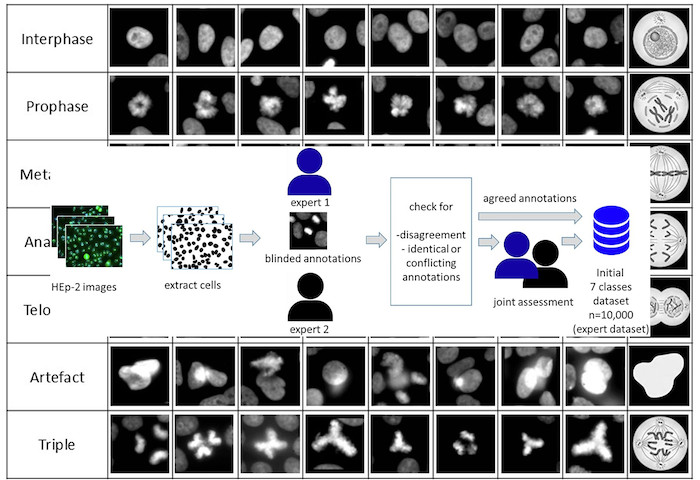
In this study, we introduce a large-scale, high-resolution dataset consisting of 100,000 single-cell images of human HEp-2 cells. By combining expert manual annotations with deep learning (CNN) techniques, we have captured and classified the different phases of the cell cycle (from interphase to telophase).
The identification of mitotic figures is one of the most critical tasks in autoimmune diagnostics, particularly regarding the assessment of Antinuclear Antibodies (ANA). Because manual interpretation is often subject to human bias and morphological variability, our dataset provides a good resource for developing robust and smart algorithms. We think is a useful contribution toward standardizing and improving the precision of computer-aided diagnosis (CAD) of autoimmune diseases.
While we celebrate this scientific milestone, it is also a moment of deep gratitude and remembrance. We recently lost Karsten Conrad, who passed away at the age of 70. Privatdozent Dr. med. Karsten Conrad was until his retirement head of the Laboratory for Autoimmune Diagnostics at the Institute of Immunology, Carl Gustav Carus Faculty of
Medicine, Technical University Dresden.
Karsten was a mentor and a constant companion on my scientific journey. I remember clearly the early stages of my career in 2007/2008, when he supported me by publishing some my (first?) scientific documents in his book series. His guidance during those formative years was important to me.
I perceived Karsten as an incredibly active and prolific author, contributing numerous significant publications that have shaped the field. Beyond his research, he was a highly respected by everybody I know. I was happy to have at my conference, the International Biotech Innovation Days (IBID), later in career.
He was the driving force behind Association for the Advancement of Immune Diagnostics (GFID) (est. 2002) the world-renowned Dresden Symposium on Autoantibodies, which has served as a vital international platform for scientific exchange for 35 years.
I can certainly say that Karsten’s legacy is immense. His extensive body of work, his prolific writing and his dedication to research will surely continue to guide and benefit generations of scientists, physicians, and, most importantly, the patients who rely on this expertise.
Dear Karsten, thank you for your passion, your profound expertise, and your unwavering support.
#Immunology #AutoimmuneDiseases #ArtificialIntelligence #DeepLearning #Diagnostics #Biotechnology #ScientificData #InMemoriam