1. Figure from the Nature paper -
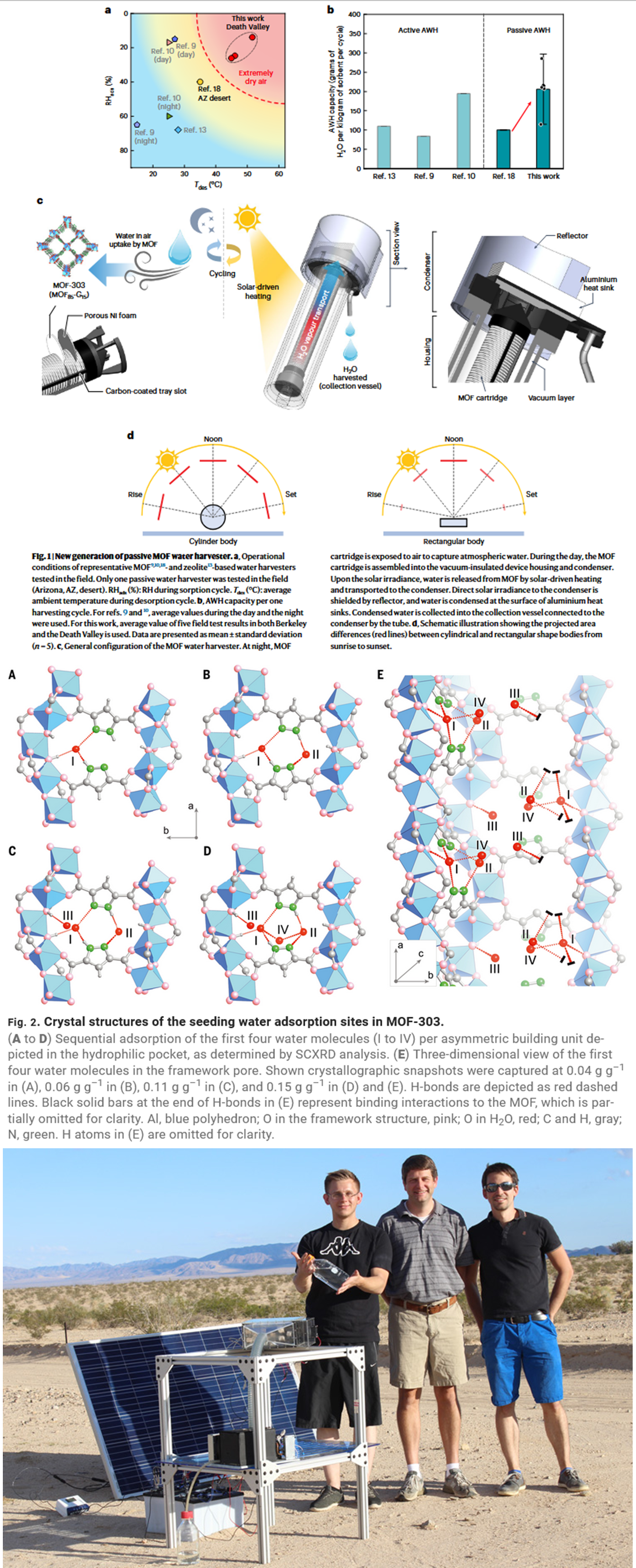
New generation of passive MOF water harvester.
a, Operational conditions of representative MOF and zeolite -based water harvesters tested in the field. Only one passive water harvester was tested in the field (Arizona, AZ, desert). RHads (%): RH during sorption cycle. Tdes (°C): average ambient temperature during desorption cycle.
b, AWH capacity per one harvesting cycle.
c, General configuration of the MOF water harvester. At night, MOF cartridge is exposed to air to capture atmospheric water. During the day, the MOF cartridge is assembled into the vacuum-insulated device housing and condenser. Upon the solar irradiance, water is released from MOF by solar-driven heating and transported to the condenser. Direct solar irradiance to the condenser is shielded by reflector, and water is condensed at the surface of aluminium heat sinks. Condensed water is collected into the collection vessel connected to the condenser by the tube.
d, Schematic illustration showing the projected area differences (red lines) between cylindrical and rectangular shape bodies from sunrise to sunset.
2. Graphic showing crystal structures of the seeding water adsorption sites in MOF-303.
Source: https://www.science.org/doi/10.1126/science.abj0890
3. Berkeley graduate students display the water collected from the water harvester in the Mojave Desert in 2019. (Photo courtesy of Mathieu Prévot, UC Berkeley)


The Nobel Prize in Literature for 2025 is awarded to the Hungarian author László Krasznahorkai.
“for his compelling and visionary oeuvre that, in the midst of apocalyptic terror, reaffirms the power of art”.
"László Krasznahorkai is a great epic writer in the Central European tradition that extends through Kafka to Thomas Bernhard, and is characterised by absurdism and grotesque excess."
https://www.nobelprize.org/prizes/literature/2025/bio-bibliography/
10/n