This paper by @rupdecat@fediscience.org looks interesting
Sustainable data analysis with Snakemake - PMC: pmc.ncbi.nlm.nih.gov/article...
Discussion
This paper by @rupdecat@fediscience.org looks interesting
Sustainable data analysis with Snakemake - PMC: pmc.ncbi.nlm.nih.gov/article...
Now a thread covering my experiencing publishing content / creating posts
Now, about publishing content:
Again, publishing posts is quite straightforward. It has anything you'd expect:
Once I sent to "Post", I get a modal window (it was difficult for me to see, TBH, because it is displayed on the top of the window and not very prominently) confirming that the post has been published.
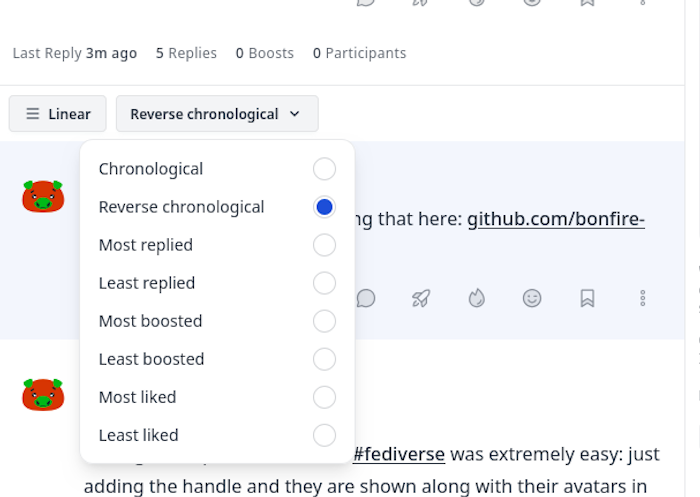
Once I like some #bonfire specific features here, such as changing how replies are sorted ❤️:
This is really cool, indeed! Following conversations on mastodon is difficult, and I feel/hope this can make this process easier.
I've noticed that likes are not shown in the post's page
I'll try to write about my experience here, both as a test and as a diary for future reference.
My first contact with #bonfire is that it ressembles a lot with #mastodon, so it feels like at home. My first task was to fill in my profile. It was a very straightforward and familiar process, but two subtlelties (not maybe not too subtle) got my attention: the possibility of linking my orcid and other profiles. That looks interesting!
A thread about federation
very briefly, as I am on my phone now.
I've found the following issues about federation:
Linking other Fediverse accounts
Adding other profiles from the #fediverse was extremely easy: just adding the handle and they are shown along with their avatars in the profile.
I tried with adding #mastodon and #pixelfed accounts and both worked great.
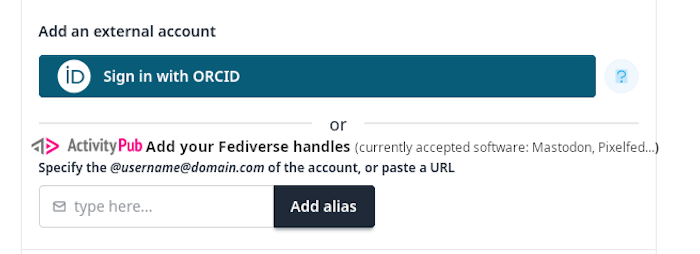
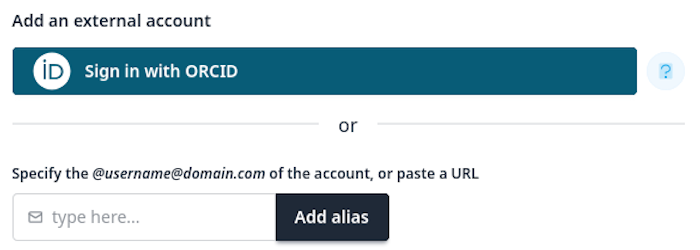
My only concern is that I didn't know what to add on that section of the profile from reading the texts. It was not until I saw @mayel@bonfire.cafe 's profile that I understood that we were expected to add user handles from the fediverse. I'm not sure if any software using #ActivityPub will work here either, so I imagine that a better text, and potentially highlighting ActivityPub icon, would be appreciated. I took the liberty of proposing something in this quite clumpsy screenshot.
I just created an issue suggesting that here: github.com/bonfire-networks/...
Linking ORCID
When I tried to link my orcid, I got an error. After reporting the issue in the matrix room, @mayel@bonfire.cafe and @ivan@bonfire.cafe almost immediately fixed the issue.
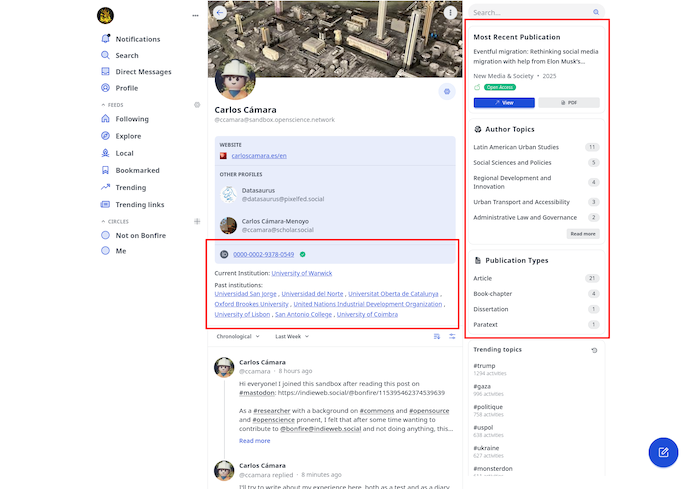
Once the issue was sorted, linking my orcid was as straightforward as with any other service using orcid. Not only that, but it populated my profile with very interesting data for #academics: a list of current and former institutions where I work/have worked, my most recent publication, the topics I write about and publication types.
I find this implementation to be very neat and useful for the use case of open science, so kudos to @Bonfire@bonfire.cafe for this great idea. I particularly love how the last publication is displayed, showing if it's open access, and links to the article and to the PDF version. Amazing! 🎉 (probably, I'd prefer to choose the publication I want to show there, but the last one is a good default criteria, so this is me being picky)
Linking other Fediverse accounts
Adding other profiles from the #fediverse was extremely easy: just adding the handle and they are shown along with their avatars in the profile.
I tried with adding #mastodon and #pixelfed accounts and both worked great.
My only concern is that I didn't know what to add on that section of the profile from reading the texts. It was not until I saw @mayel@bonfire.cafe 's profile that I understood that we were expected to add user handles from the fediverse. I'm not sure if any software using #ActivityPub will work here either, so I imagine that a better text, and potentially highlighting ActivityPub icon, would be appreciated. I took the liberty of proposing something in this quite clumpsy screenshot.
My only issue with this is that all this data is pulled from openalex.org/ which is an amazing service, but it does make mistakes in assigning publications to authors. In my case, I have assigned as my own some publications written by someone with a similar, Portuguese name , and as a result, the fields and institutions are not correct.
I have reported this inaccuracies to openalex and I hope they fix them soon, but considering that:
I wonder if it wouldn't be better to get affiliations from orcid's API instead.
I suggested that in the #element / #matrix channel and n@ivan@bonfire.cafe immediately created an issue on their Github repo: github.com/bonfire-networks/...
Again, kudos to bonfire admins!
Hi everyone! I joined this sandbox after reading this post on #mastodon: https://indieweb.social/@bonfire/115395462374539639
As a #researcher with a background on #commons and #opensource and #openscience pronent, I felt that after some time wanting to contribute to @bonfire@indieweb.social and not doing anything, this was the time to join the community and try to contribute!
I'll try to write about my experience here, both as a test and as a diary for future reference.
My first contact with #bonfire is that it ressembles a lot with #mastodon, so it feels like at home. My first task was to fill in my profile. It was a very straightforward and familiar process, but two subtlelties (not maybe not too subtle) got my attention: the possibility of linking my orcid and other profiles. That looks interesting!
Hi everyone! I joined this sandbox after reading this post on #mastodon: https://indieweb.social/@bonfire/115395462374539639
As a #researcher with a background on #commons and #opensource and #openscience pronent, I felt that after some time wanting to contribute to @bonfire@indieweb.social and not doing anything, this was the time to join the community and try to contribute!
test link csarven.ca/linked-data-notif...
test two linkedresearch.org/calls#con...
Just published in JOSS: 'rhap: A tool to analyze health impacts attributable to household air pollution' https://doi.org/10.21105/joss.08091
@joss@fosstodon.org Looks very useful for teaching.
I just read the paper about #openalexR, an #rstats package to work with data from #OpenAlex.
Aria, M., Le Trang, Cuccurullo, C., Belfiore, A., & Choe, J. (2024). openalexR: An r-tool for collecting bibliometric data from OpenAlex. The R Journal, 15, 167–180. https://doi.org/10.32614/RJ-2023-089
This package is useful to work with scholarly literature as this demands efficient tools for bibliometric analysis, science mapping, and research assessment. OpenAlex, a large open database of academic metadata, provides free access to comprehensive bibliometric data, but accessing and analyzing this data can be technically challenging. For example, we used an OpenAlex csv data dump in a review about the #Fediverse and open source software [1].
openalexR, an R package, which is offering a user-friendly interface to the OpenAlex API. This package enables researchers to query, download, and analyze metadata on works, authors, institutions, sources, concepts, and more, with minimal coding expertise. Key features include oa_fetch for data retrieval, oa_snowball for automated citation-based literature searches, and oa_ngrams for text analysis. By converting API responses into structured data frames. Thus, it should be a nice tool for bibliometric studies, literature reviews, and science mapping. This might also come handy to identify trends, map collaborations, and assess scholarly impact. Be warned, the OpenAlex data is far from complete or perfect.
[1] Rödiger, S., Kögler, M., Birkholz, M., 2024. Open-Source Software, Fediverse and Custom ROMs as Tools for a Sustainable Internet, in: 2024 Electronics Goes Green 2024+ (EGG). Presented at the 2024 Electronics Goes Green 2024+ (EGG), pp. 1–13. https://doi.org/10.23919/EGG62010.2024.10631179
I just read an interesting paper about #Sweave and tooling for reproducible research by Roger D. Peng, which was very important for #rstats before #RMarkdown and #Quarto. I can recommand to read it.
Peng, R. (2025). Tooling for Reproducible Research: Considerations for the Past and Future of Data Analysis. Austrian Journal of Statistics, 54(3), 1–8. [https://doi.org/10.17713/ajs.v54i3.2052](https://doi.org/10.17713/ajs.v54i3.2052)
It is alos in memoriam of Fritz Leisch (31 July 1968 - 24 April 2024), who made major contributions to this area.
This is the link to the whole issue in the Austrian Journal of Statistics.
[https://ajs.or.at/index.php/ajs/issue/view/120](https://ajs.or.at/index.php/ajs/issue/view/120)
We published another review about Neurodegenerative diseases.
Alzheimer’s, Parkinson’s, Huntington’s, and Amyotrophic Lateral Sclerosis (ALS) affect millions worldwide, posing significant challenges for early detection and effective treatment. But what if the key to unlocking new diagnostics and therapies lies in tiny molecules called microRNAs (miRNAs)? These small, non-coding RNAs regulate gene expression and have emerged as promising biomarkers and therapeutic targets for neurodegenerative diseases. This is something we addressed in our first review:
Azam, H.M.H., Rößling, R.I., Geithe, C., Khan, M.M., Dinter, F., Hanack, K., Prüß, H., Husse, B., Roggenbuck, D., Schierack, P., Rödiger, S., 2024. MicroRNA Biomarkers as Next-Generation Diagnostic Tools for Neurodegenerative Diseases: A Review. Front. Mol. Neurosci. 17. doi.org/10.3389/fnmol.2024.1...
Our second (final) review further explores the of miRNAs in understanding, diagnosing, and treating these debilitating conditions.
Azam, H.M.H., Mumtaz, M., Rödiger, S., Schierack, P., Hussain, N., Aisha, A., 2025. MicroRNAs in neurodegenerative diseases: from molecular mechanisms to clinical biomarkers, detection methods and therapeutic strategies—advances and challenges. Neurol Sci. doi.org/10.1007/s10072-025-0...
Part of this are information about the role of microRNAs in neurodegenerative diseases. This time we have a more bioanalytical/biosensoric perspective. One of the most exciting aspects of miRNA is their potential as less-invasive biomarkers. MiRNAs are released into biofluids like blood and cerebrospinal fluid (CSF) via extracellular vesicles, making them more accessible for diagnostic testing. Advanced detection methods, such as RT-qPCR, next-generation sequencing (NGS), and microfluidic chips, are being developed to measure miRNA levels with high sensitivity and specificity. Emerging technologies, like lateral flow assays and electrochemical biosensors, are also being explored for point-of-care diagnostics, which could revolutionize how we detect and monitor neurodegenerative diseases in clinical settings.
Beyond diagnostics, miRNAs hold promise as therapeutic agents. Researchers are exploring two main strategies, which are miRNA Inhibition and miRNA Replacement. However, challenges remain, particularly in delivering miRNAs to the brain due to the blood-brain barrier. Innovative delivery systems, such as viral vectors, liposomes, and exosomes, are being developed to overcome these barriers and improve the efficacy of miRNA-based therapies.
While the potential of miRNAs is immense, several challenges must be addressed to translate research into clinical practice. These are standardization (there is a need for standardized protocols in miRNA extraction, detection, and data analysis to ensure reproducibility across studies), specificity and Sensitivity (miRNAs often share high sequence similarities, making it difficult to design probes that can distinguish between them. Advanced technologies like locked nucleic acid (LNA) probes and CRISPR-based detection are being explored to improve specificity) and presumably the deciding aspect regulatory approval (miRNA-based diagnostics and therapeutics must meet stringent regulatory requirements, which can delay their clinical adoption).
#NeurodegenerativeDiseases #MicroRNAs #Biomarkers #Therapeutics #Neuroscience #PrecisionMedicine #miRNA
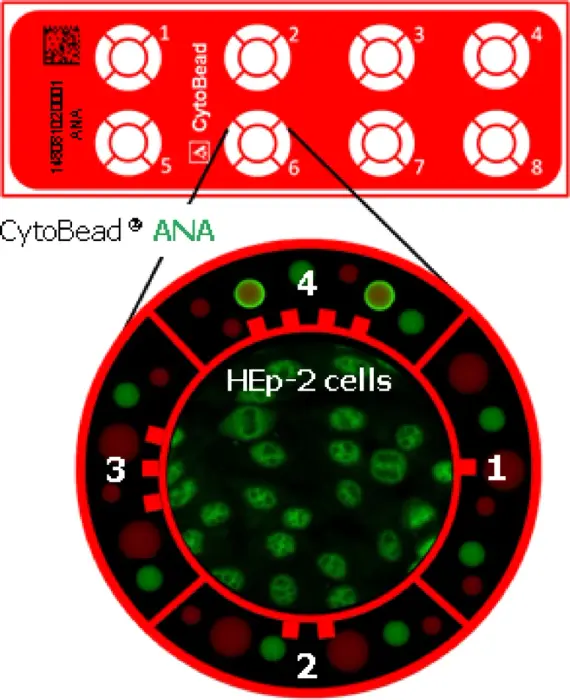
Our new study evaluates the performance of the CytoBead ANA 2 assay, a novel one-step method for detecting antinuclear antibodies (ANA) and specific autoantibodies in systemic autoimmune rheumatic diseases (SARDs).
We compared CytoBead ANA 2 to traditional ANA indirect immunofluorescence (IIF) and the BioPlex™ 2200 multiplexed assay, finding substantial agreement (κ=0.74) and comparable diagnostic accuracy. The assay also effectively identified the dense-fine speckled (DFS) pattern associated with anti-DFS70 antibodies in non-SARDs patients.
This approach streamlines ANA testing by combining screening and confirmation in a single step, offering a promising alternative to the current two-tier process.
Read the full paper: Nature Scientific Reports
#Autoimmunity #Rheumatology #Diagnostics #ANA #Research

Install Open Science
Get the full app experience