I am pleased to share our recent work published in Scientific Reports, a collaborative study with my PhD student, Husain Muhammad Husnain Azam.
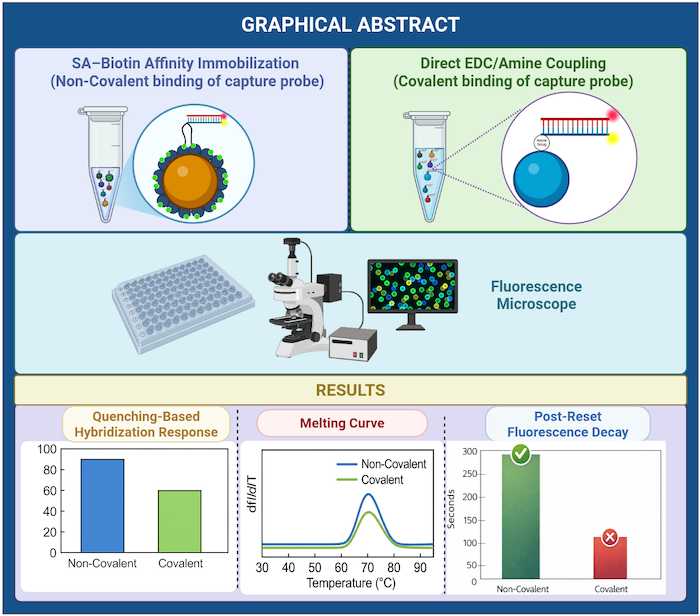
In this study, we investigated how different immobilization strategies influence the functional performance of miRNA hybridization on carboxylated PMMA microbeads. We compared direct EDC/amine coupling with SA-biotin affinity immobilization to determine how the surface architecture affects probe accessibility and signal reproducibility.
A key question we addressed was whether the amine groups inherent in the nucleic acid structures themselves contribute to the binding with the carboxylated surface, and if this interaction affects the hybridization profiles and melting temperatures.
The answer is not that simple. Our results provide indications that these amine-carboxyl interactions do play a role. However, we found that other factors are much more dominant in driving the observed differences. Here specifically, the significant variations in apparent probe loading and the resulting steric and electrostatic constraints at the interface.
The full paper shows a detailed analysis of the quenching-based hybridization response and the post-reset fluorescence decay
Read the full article here:
doi.org/10.1038/s41598-026-6...
#MicroRNA #Biosensors #SurfaceChemistry #Microbeads #Hybridization #ScientificReports #Biotechnology***